A Place Name Is Not a Complete History
A place name can hold several histories at once. Learn how to read spelling, local speech, maps, and landscape without mistaking a plausible meaning for proof.
What does a place name really mean if its spelling, pronunciation, and surroundings seem to point in different directions? A place name is not a complete history: it may preserve an older sound, reflect a later spelling, or carry more than one explanation without settling on a single origin.
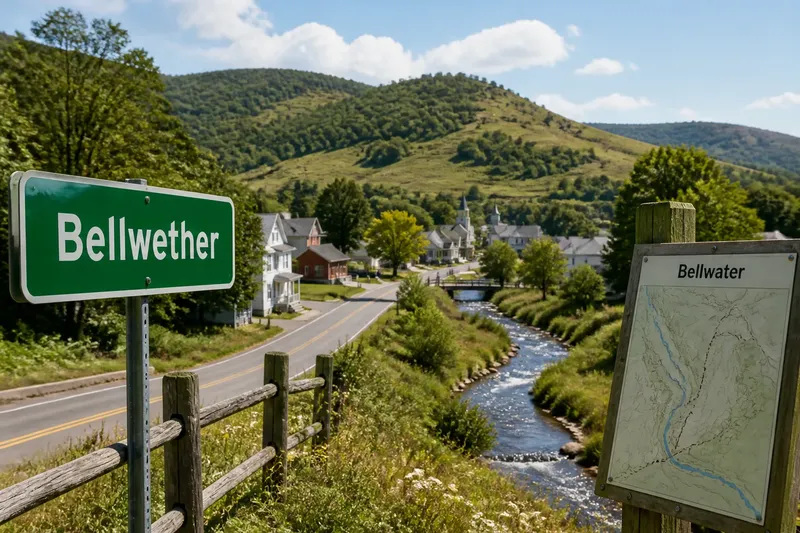
Imagine you are trying to understand Bellwether, a small, entirely invented settlement beside a low ridge and a bend in a creek. A road sign spells it Bellwether; longtime residents say “Bell-wether,” while a nearby trail map prints “Bellwater.” The hill is not especially high, and there is no obvious bell tower. Each clue invites a story. None, by itself, establishes one.
This imagined case offers a useful way to examine what a name can tell you, what it cannot, and how to keep a plausible interpretation from turning into a confident but unsupported history.
Begin with the mismatch
Suppose you first encounter Bellwether on a current map. The written form suggests familiar English words: a bell and a wether, or perhaps a marker associated with sheep. Then you hear a local say the name aloud, and the final sound seems closer to “water.” The landscape supplies yet another possibility: the settlement sits near a creek.
It is tempting to combine those clues into a tidy account. Perhaps sheep grazed the ridge, a bell marked the flock, and the creek gave the place its other pronunciation. But that story joins separate observations into a chain of events for which you have no evidence. Familiar words can make a name look more transparent than its history actually is.
In this invented situation, the mismatch is not a problem to erase. It is the starting point. The spelling, spoken form, and physical setting are different kinds of evidence; they may relate to one another, but they should not be treated as interchangeable.
Read the layers separately
A name can pass through several stages before it appears on a road sign. People may use a spoken name long before anyone writes it down. A mapmaker or clerk may record that sound using familiar letters, and later copies may preserve the written form even after local pronunciation shifts. The resulting name can carry traces of different moments rather than a single, perfectly preserved label.
For Bellwether, imagine that a local school map uses “Bellwater,” a road sign uses “Bellwether,” and residents continue to disagree about the vowel. Those differences would show variation in the forms currently encountered. They would not reveal which form came first, who introduced it, or why it changed. To answer those questions, you would need dated records or reliable local accounts that actually address the name.
Even a sequence of spellings needs care. A written form may be an attempt to represent a sound, not a faithful record of an earlier word. Someone copying a name can alter a letter, regularize an unusual spelling, or preserve a choice made for reasons that are no longer apparent. A map is valuable evidence of how a name was written there, but it is not automatically an explanation of its origin.
Separate clues from conclusions
Keep a short evidence note before choosing an interpretation. For this fictional place, it might look like this:
- Recorded form: Bellwether appears on the road sign. This establishes the sign’s spelling, not the name’s earliest form.
- Local pronunciation: Some residents say “Bell-wether,” while others hear “Bellwater.” This establishes variation in present speech, not its cause.
- Map variation: An imagined trail map says Bellwater. It raises a question about differing records but does not establish which label is older.
- Landscape: A creek and a ridge are nearby. Their presence makes certain interpretations imaginable, not proven.
- Missing evidence: No dated document or account explaining the name has been found in this scenario. The origin therefore remains unresolved.
This separation makes a small but important difference in wording. “Bellwether may be connected to a local feature” is a possibility. “Bellwether was named for the creek” is a historical claim. A claim needs support that links the name to that feature, rather than merely showing that the feature exists.
If you are keeping notes for a family, classroom, walking group, or local-history project, mark uncertainty plainly. Write down where each spelling appeared and who uses each pronunciation, without silently treating one form as the authentic version. A simple record of what you observed is often more useful than an early guess presented as fact.
Ask what records can show
The next move in the invented Bellwether case is to look for records that might clarify the differences. Useful materials could include older local maps, property documents, postal directories, school records, road signs, or place-name collections held by a library or historical society. A town clerk or local historian may also know where relevant records are kept.
Each source answers a limited question. A map can show that a particular spelling appeared in a certain edition. A directory can show how a place was labeled for a particular purpose. A resident can describe how family or community members pronounce the name. None necessarily explains the original naming event, and two sources may reflect different habits rather than a simple progression from old to new.
Compare records by what they are and what they were made to do. A hand-drawn map meant for local use might preserve a spoken form that an official sign does not. A newer map may copy an older label rather than independently confirm it. If two documents agree, that agreement is useful, but it does not tell you whether one copied the other.
For the imagined Bellwether search, suppose an older map prints “Bellwater,” and a later directory uses “Bellwether.” That would support the modest statement that both written forms appeared in records from different periods. Without a note explaining the change, it would not prove that one name was corrected, mistranscribed, or derived from the creek.
Keep sound and spelling distinct
Pronunciation can preserve clues that writing obscures, but speech is not a time machine. People may pronounce the same spelling differently, and a community’s speech can change while its signs remain fixed. Conversely, an official spelling can change even when many residents keep using an older-sounding form.
When asking someone how they say Bellwether, listen first rather than presenting a theory. You might ask, “How do you pronounce this name?” and then, if the person is comfortable, “Have you heard another pronunciation?” That approach records what people say without nudging them toward the creek, the ridge, or the animal suggested by the written word.
It also helps to distinguish the person’s account from the explanation attached to it. “My family says Bellwater” is a report about family usage. “The name comes from the creek” is an origin claim. A speaker may know both, but one does not automatically establish the other.
Where the right form matters for an official record, follow the relevant local authority’s naming guidance. For an informal map or conversation, it can be clearer to note the variant and its source instead of declaring a winner on thin evidence.
Use landscape with restraint
Physical features can help generate questions. A creek near a name that sounds like “water” may be worth recording; a ridge near a name that seems to refer to a hill may invite another line of inquiry. Yet a feature’s presence does not establish that residents named the place after it. The feature might have gained its own name later, or the apparent connection might be coincidence.
In the Bellwether scenario, walking from the road sign to the creek would help you identify which creek people mean and how close it is to the settlement. It would not reveal whether the written name once had a different sound. A field visit can clarify the geography; records and informed local accounts are better suited to questions about how a name arose.
It is not worth the effort to force every syllable into a neat modern word or to search the landscape for a feature that makes a favorite story fit. That can produce a memorable explanation while adding no dependable evidence. Let an unresolved name remain unresolved when the record does not carry the story further.
What can a name tell you?
Does a place name have one correct meaning?
Sometimes a name’s origin is well documented; in other cases, the evidence supports more than one possibility or leaves the question open. A familiar-looking word is not enough to settle the matter, so distinguish a documented explanation from a plausible reading.
Can an older map prove a name’s origin?
An older map can show that a spelling was used on that map, and comparison with other records may help trace variation. Unless it includes reliable information about the naming itself, it does not prove why the place received that name.
Should local pronunciation outrank the sign?
Local speech and official spelling answer different questions: one records how people say a name, the other how an authority writes it. Note both when they differ, and use the form required for the setting in which you are writing or speaking.
What if explanations conflict?
Record who offers each explanation and what evidence accompanies it, then avoid presenting either account as settled unless the sources support that confidence. A clear “the origin is uncertain” is more informative than a confident story assembled from a suggestive spelling and nearby scenery.
Leave room for uncertainty
Return to the imagined Bellwether after gathering the sign, map, spoken forms, and landscape notes. The careful result might be: “Bellwether is the spelling on the road sign; a local trail map uses Bellwater, and residents pronounce the name in more than one way. A creek lies nearby, but the origin has not been established.” That description gives a reader useful information without pretending the clues form a complete history.
If later records emerge, revise the account and say what the new evidence changes. A dated local document that explicitly explains the naming would carry more weight than another map that simply repeats a spelling. Until then, the best account may preserve the layers rather than flatten them into one answer.
That is the practical value of treating a place name as a record with limits. The name can connect spoken memory, written labels, and the nearby landscape, while still leaving its beginning uncertain. When you describe Bellwether—or any place whose name seems self-explanatory—say what you can point to, identify what remains a possibility, and let the distinction stand.